About eGo
What is eGo?
eGo (electricity grid optimization) is an open-source Python package for the cross-grid-level analysis of flexibility deployment and grid expansion in sector-coupled energy systems. It combines eTraGo and eDisGo in a top-down workflow.
eTraGo optimizes generation and flexibility dispatch as well as grid and storage expansion at the extra-high- and high-voltage levels. Relevant results and operational requirements are transferred to eDisGo, which analyses the underlying medium- and low-voltage grids and determines their grid reinforcement needs. eGo links both tools, coordinates the cross-grid-level workflow, and provides functionality for the joint evaluation of results.
Research context
eGo was initially developed in the research project open_eGo and was further developed and applied in the research project eGon.
The eGon project extended the modelling framework by a sector-coupled data model that includes electricity, heat, gas, and mobility as well as various flexibility options.
The cross-grid-level methodology and its application to a German 2035 scenario are described in Büttner et al. (2025).
The Open Energy Platform
The Open Energy Platform (OEP) provides open data and metadata for transparent and reproducible energy system modelling. Parts of the data used by eGo and related tools in the openego toolchain are made available through the OEP.
eGo uses the ego.io package to access data from the Open Energy
Database through the OEP REST API. A registered OEP account is required
for workflows that access the database through this interface.
Depending on the selected workflow, eGo may alternatively use imported results or locally available data. Further information on data access and configuration is provided in the installation and getting-started sections.
Model overview
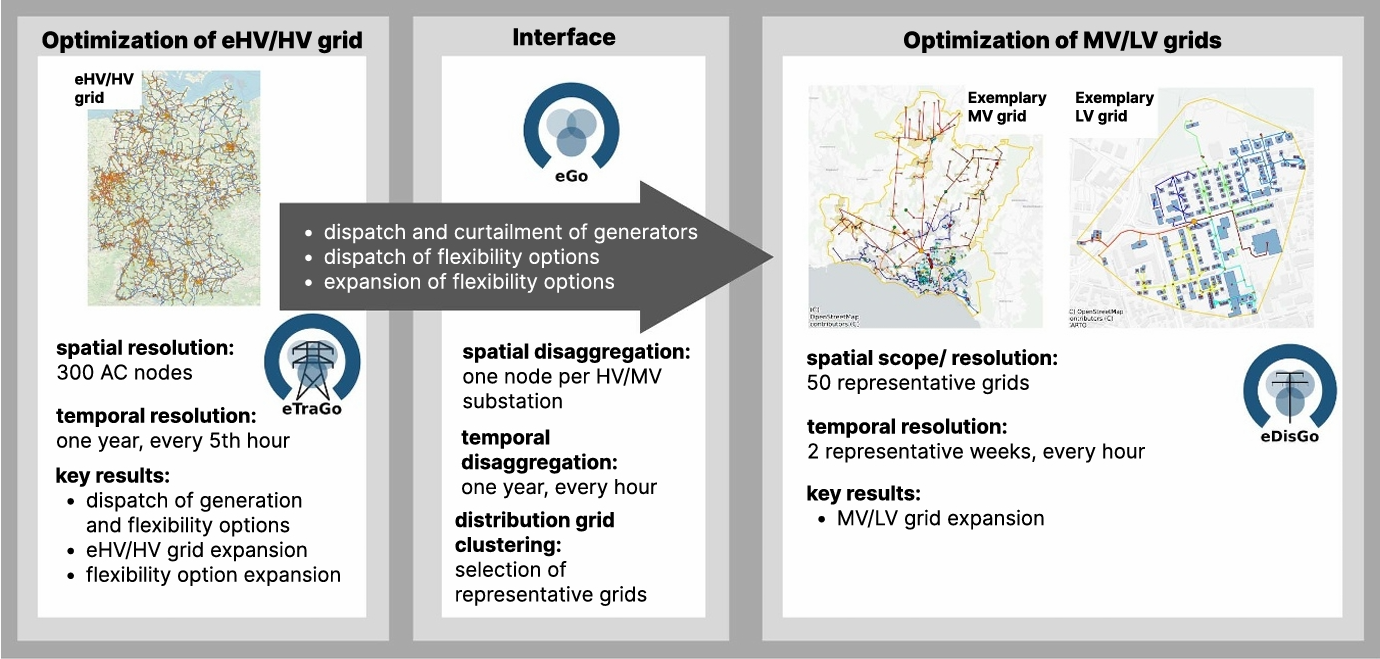
eTraGo
eTraGo is an open-source Python package based on PyPSA. It is used to optimize generation and flexibility dispatch as well as grid and storage expansion at the extra-high- and high-voltage levels.
Within the eGo workflow, the results of the eTraGo optimization provide the basis for the subsequent analysis of the underlying medium- and low-voltage grids.
eGo interface
eGo links eTraGo and eDisGo in a top-down workflow. It provides the interface between both tools, prepares and transfers relevant results, and provides an MV-grid clustering method for selecting representative distribution grids.
This enables the results and operational requirements from the upper-grid-level optimization to be considered in the subsequent distribution-grid analysis.
eDisGo
eDisGo is used for the analysis of medium- and low-voltage grids. Based on the inputs prepared by eGo, eDisGo analyses representative distribution grids and determines their grid reinforcement needs.
Supported by
This project is supported by the German Federal Ministry for Economic Affairs and Energy (BMWI).

License

© Copyright 2015-2018
Flensburg University of Applied Sciences, Europa-Universität Flensburg, Centre for Sustainable Energy Systems
This program is free software: you can redistribute it and/or modify it under the terms of the GNU Affero General Public License as published by the Free Software Foundation, either version 3 of the License, or (at your option) any later version.
This program is distributed in the hope that it will be useful, but WITHOUT ANY WARRANTY; without even the implied warranty of MERCHANTABILITY or FITNESS FOR A PARTICULAR PURPOSE. See the GNU Affero General Public License for more details.
You should have received a copy of the GNU General Public License along with this program. If not, see www.gnu.org/licenses.
Partner


